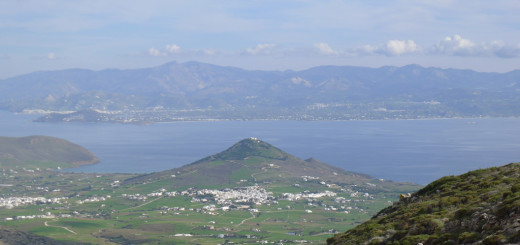
The Valley of Lefkes & the Byzantine Way: 3 Hikes
Easy walks or rewarding hikes (5/9/11km), our three hikes in the broader Lefkes, Prodromos and Marpissa area have it all; traditional village charm, the famous Byzantine Way, countryside nature, rugged hillsides and old monasteries and chapels! (Click on alternative routes below for details)


Lefkes village with Holy Trinity
Description This is a 5km circular hike accessible to most, combining traditional village charm, rural beauty… and a traditional coffee & sweets ending!
Using private transfer private transfer/ on the morning bus from Parikia (10 km), we arrive at Lefkes village, the biggest inland settlement in medieval times. We start at the main village square with a short tour around the labyrynthine alleys and the stacked white-washed houses, visiting chapels, the cathedral and & other picturesque corners of the traditional village that dates back to the 10th c. AD. Then, we find the beginning of the so-called “Byzantine Way”, a stone-paved donkey trail built centuries ago to connect the island’s main villages. We start on a mostly downhill route affording great views to the Paros-Naxos channel and walk on age-old marble rocks that pave the way to Prodromos village. As we go by ancient terraced hillside fields (‘pezoules’), farmers’ stone huts and Byzantine-age stone-built bridges, we admire centuries-old olive trees and savour the sweet scent of the various wild aromatic herbs that border the route (sage, oregano, thyme, wild fennel, honeysuckle and felty germander – ‘Teucrium Polium’).
Half-way to Prodromos village, we leave the Byzantine way to start on a winding dirt track through fruit orchards, olive groves and vineyards. The track becomes the old, narrow stone cutters’ trail (that used to connect the village with the nearest marble quarry), which climbs up to the Holy Trinity church (with is sculpted marble iconostasis) and the old square of Lefkes, where our efforts are rewarded with a nice cup of Greek coffee and traditional hand-made cookies and sweets at a local cafe (included in tour price).
Questions or more info? Ask here.
In a nutshell [A walk in the heart of Paros] Countryside/traditional village/history/taste, easy, distance 5 km, net elevation gain/loss ±80 m, duration 3h30m (walking time: 2h30m).

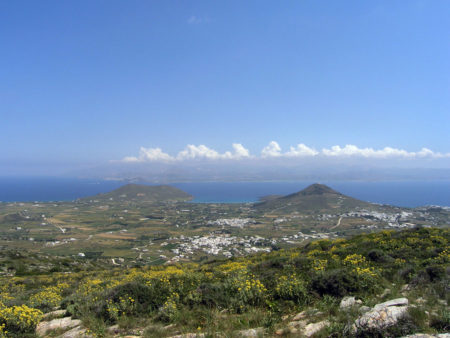
Rachi Hill: View to the E-NE
Description Sharing a part of Route 1, this route offers hikers a taste of traditional culture & architecture, as well a rewarding hike in unspoilt Cycladic countryside! We start at Lefkes, the medieval central village (founded in the 9th c. AD to protect the island population from the Saracen pirate raids), and walk through the centuries-old, maze-like alleys with houses blending the traditional cube-like Cycladic style with the neoclassical. We visit chapels (sometimes built with architectural salvage from ancient temples), the old village square and the marble-built cathedral of Holy Trinity – where the Byzantine Way can be spotted, a serpentine unfolding on the terraced hillsides opposite the church.
We walk the ancient, herb-scented trail to its highest vantage point, enjoying views of Paros east coast and the surrounding island in the distance (Naxos, Koufonis, Iraklia & Ios). we leave the stone-paved main path to take a narrow, winding shepherds’ footpath uphill. We scramble up ancient stone-built terraces to find old farmers’ stone huts, threshing grounds and other abandoned agricultural installations. This rugged trail finally takes us to the top of Rachi hill (+325m). After exploring (and learning the story of) the mysterious giant stone cairns lining the hilltop we pause to enjoy sweeping, panoramic views to the island’s coastline to the N & E, the Paros-Naxos channel, the surrounding islands and the open sea. We then go downhill on more rugged shelpherd’sd trails and after a while, the white-washed bulk of the monastery of Agia Kyriaki comes in sight, tucked away deep in the valley of Lefkes. Built in the 17th c., this is a typical, well-preserved specimen of the late-medieval fortified monasteries that abound in the Cycladic islands. After visiting the monastery church, its inner courtyard and facilities (upon availability of the monastery keepers) and a snack break, we take the return road to Lefkes, walking over the old windmill area on dirt track and walled old footpath (or on easy dirt road – for evening/starlight tours), and enjoying beautiful views down to the valley of and the sea, as well as of the amphitheatric layout of the traditional village.
Questions or more info? Ask here.
In a nutshell [Hike deep in the Parian countryside & tradition] Countryside/hillsides/traditional villages/history, moderate diff., distance 9km, net elevation ±120m, duration 4h-4h30m (incl. breaks).

Piso Livadi and Kefalos Hill
Description The hike start is at Lefkes, the highland village of Paros, founded around the 9th c. AD to protect the island population from the Saracen pirate raids. We walk through the centuries-old, maze-like alleys with houses blending the traditional cube-like Cycladic style with the neoclassical, and around chapels down to the old village square. As we exit the village we admire the marble-built bell towers of Holy Trinity Church, as we start on the historic Byzantine Way. This is the best-known hiking route on Paros, a winding, mostly downhill trail that hugs the terraced hillsides around Lefkes. Delapidated windmills, old stone-built stables, olive and grape presses, and farmers’ huts tell the nearly forgotten tale of traditional agriculture of the Cycladic islands.
As we go down the full length of this marvelous marble-paved footpath (the work of successive generation of islanders dating back to the medieval times), we enjoy shifting perspectives of the terraced hillsides and the mountains, as well as of the N & E coastline, the surrounding islands and the Paros-Naxos channel. In spring and early summer, the trail is bordered with multi-colored wild flowers (cistus, lilies, irises, chrysanthemums, poppies, St. John’s wort, phlomis, sheep sorrel, dock, mallow, even wild gladiolas and orchids!), a pot-pourri of fragrant herbal bush (oregano, sage, savory, rue, spiny broom and fennel), as well as cypress, juniper, pine and olive trees. Aftrr an hour and a half of walking on the Byzantine Way, we reach the quaint village of Prodromos, its cluster of white-washed houses built after the 17th century around the church of St John the Baptist (or St. John the Forerunner, the “Prodromos”).
We leave the village behind and take a short sterch of asphalt-paved carriage road, folowed by an uphill cement road in the direction of the church of the Transfiguration of Christ on the highest point of Marpissa village.
In Marpissa, we explore the quiet, narrow cobblestone alleys of Marpissa, going under characteristic arched passageways to find beautiful white-washed houses, chapels and churches. This is a village that has surprisingly remained outside the main tourist itineraries, where life seems to follow the relaxed pace of “the olden days”.
After passing by the trio of the old windmills of Marpissa, we continue to Piso Livadi, walking briefly uphill on concrete road, and later downhill on an old walled footpath going through abandoned grain filelds. En route, we enjoy unlimited views to the green or golden-brown depending on the season) fields of Marpissa plain, the bay of Molos, and a good part of the coastline of eastern Paros. The pointed Kefalos Hill, the last bastion of Venetian Paros to fall to the Turks in 1537, dominates the landscape; it is now crowned with the miniature Aghios Antonios monastery and the old fort remains. After a stretch of dirt road right by the water and more spectacular sea views, we make out the blue dome of the chapel of Aghios Nikolaos, perched above the white washed houses of Piso Livadi. The picturesque port and the sandy beach of Piso Livadi, surrounded by cafes and restaurants, makes for a great ending to our exploration of central & eastern Paros.
A slightly extended version (11 km, 4h15m) takes us to the adjacent long and sandy beach of Logaras, where swimming and relaxing under the sea pines, can reward your walking efforts. There is also the opportunity of lunch by the water in one of the good waterfront restaurants.
Questions or more info? Ask here.
In a nutshell [Simply, a beauti- (& history-) full island hike] Traditional villages/history, age-old trails, sea & countryside views, distance 9.5/11km, net elevation +100/-220 m, duration 4h/4h15m (incl. breaks).
-
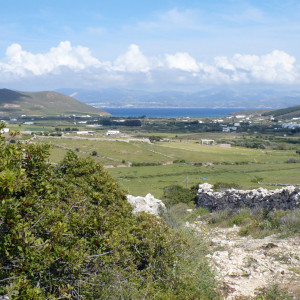
- The Byzantine Trail off Prodromos

-
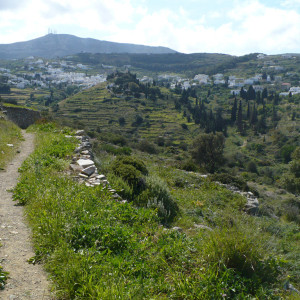
- Going towards Lefkes

-
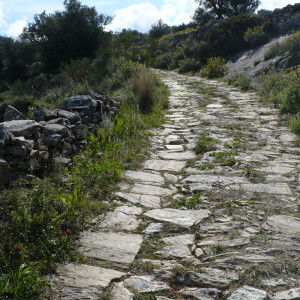
- Up the Byzantine Trail to Lefkes

-
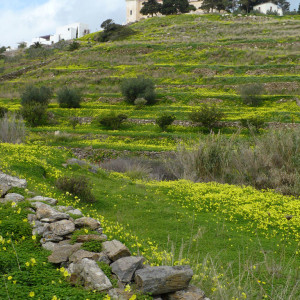
- The Lefkes Cathedral at a distance

-

- Pezoules and olive trees outside Lefkes

-
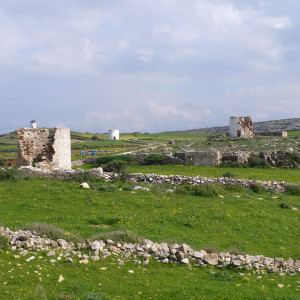
- Ruined windmills off Lefkes

-
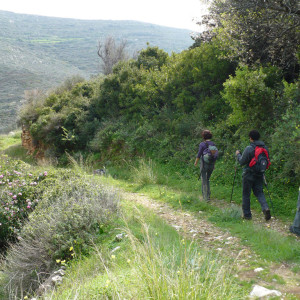
- To Aghia Kyriaki Monastery

-

- The junction to Prodromos at Rachi area

-

- Going downhill at Tourlos area close to Lefkes

-
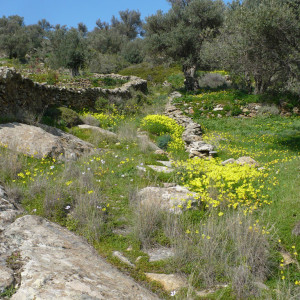
- An old footpath at Agrilies area close to Lefkes


-

- Blue-domed St.-Nikolaos church, Piso Livadi